Mouth Cancer
Mouth cancer, also called oral cancer, occurs when cells in the tissues of the mouth or throat divide without control or order, forming abnormal growths.
KEYWORDS
for searching the Internet and other reference sources
Cancer
What Is Mouth Cancer?
Mouth cancer usually begins in the tissues that make up the lips, tongue, or cheek lining, but it also can affect the gums, the floor or the roof of the mouth, or the salivary glands * . In almost all cases, it is caused by the use of substances that irritate the mucous membranes * in the mouth: spit tobacco (also called chewing tobacco or snuff), cigarettes, cigars, pipes, or alcohol. Over time, this constant irritation takes its toll, and some of the tissue takes on an abnormal appearance and eventually turns cancerous. Mouth cancer most commonly appears in men over the age of 45 who have been longtime users of tobacco and alcohol.
* salivary glands (SAL-i-var-ee glands) are the three pairs of glands that produce the liquid called saliva, which aids in the digestion of food,
* mucous membranes are thin sheets of tissue that line the inside of the mouth, throat, and other passages within the body.
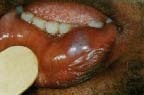
Many mouth cancers begin as whitish or reddish patches in the mouth, called leukoplakia (loo-ko-PLAY-kee-a) or erythroplakia (e-rith-row-PLAY-kee-a). Other symptoms may include:
- a sore on the lip or in the mouth that does not heal
- a lump on the lip or in the mouth or throat
- unusual bleeding, pain, or numbness in the mouth
- a sore throat that does not go away, or a feeling that something is caught in the throat
- difficulty or pain with chewing or swallowing
- swelling of the jaw
- pain in the ear
- a change in the voice.
Most dentists check for signs of oral cancer as part of the usual dental examination. Early detection is the key to treating it successfully. Otherwise, it can spread throughout the mouth, throat, neck, and even to distant parts of the body through the lymphatic system. *
How Is Mouth Cancer Diagnosed and Treated?
When dentists or doctors find a suspicious-looking area in the mouth, they may order a biopsy. During this procedure, a surgeon removes part or all of the suspect tissue. Examination under a microscope will determine whether cancer cells are present. Once oral cancer is diagnosed, doctors then need to find out whether the cancer has spread.
The first course of treatment is to remove the tumor and any cancerous tissue in the mouth. If there is evidence that the cancer has spread, the surgeon may also remove lymph nodes in the neck as well as part or all of the tongue, cheek, or jaw.
Doctors may also order radiation therapy, either before the surgery to shrink the tumors, or afterward to destroy any remaining cancer cells. In some cases, surgeons may place tiny "seeds" containing radioactive material directly into or near the tumor. Generally, this implant is left in place for several days, and the patient will stay in the hospital.
Chemotherapy is another possible treatment for mouth cancer, especially when it has spread beyond the mouth. It involves taking anti-cancer drugs by injection or in pill form.
Life after Mouth Cancer
People who are treated for large or widely spread mouth tumors often experience permanent changes that are challenging to deal with, both emotionally and physically. If they lose part of their jaw, tongue, cheek, or palate (the roof of the mouth), they will need reconstructive and plastic surgery. If surgery is not possible, they may need to use an artificial dental or facial part called a prosthesis. In either case, their appearance will be changed permanently.
These people also are likely to have some difficulty chewing and swallowing, and they may lose their sense of taste. For these reasons, weight loss can present a real problem after treatment for mouth cancer.
A Major League Fight
against Spit Tobacco
For many years, baseball great Joe Garagiola waged a one-man battle against the prevalent use of spit tobacco, also called chewing tobacco, snuff, or chew, by major league baseball players. Himself a former user, Garagiola was concerned both about the players' health and about the effect their behavior was having on young fans. He wanted to convey the message that just because spit tobacco is smokeless does not mean it is safe. To the contrary, it is a major cause of mouth cancer.
In 1996, Garagiola collaborated with a group called Oral Health America to found the National Spit Tobacco Education Program (NSTEP) and get other players involved with the cause. Bill Tuttle, who started using spit tobacco as an outfielder in the 1950s and 1960s, gave talks based on his own experiences with mouth cancer. NSTEP recruited players Lenny Dykstra, Mike Piazza, Tino Martinez, Alex Rodriguez, and Paul Molitorto do anti-tobacco spots that were broadcast during games.
* The lymphatic system (lim-FAT-ik system) is a network of vessels, organs, and tissues that produce, store, and carry infection-fighting white blood cells in a colorless, watery fluid called lymph.
Many patients have trouble speaking after losing part of their mouth or tongue. Speech therapists will work with them both during and after their hospital stay to help them get back to speaking as normally as possible.
How Is Mouth Cancer Prevented?
People can prevent mouth cancer by not using spit tobacco or smoking cigarettes, cigars, or pipes, or quitting if they already do. If they drink alcohol, they should not have more than one or two drinks per day.
Mouth Cancer
and Tobacco
Oral Health America, which runs the National Spit Tobacco Education Program, has compiled these statistics about spit tobacco use, which has increased over the past three decades.
- One out of three adolescents in the United States is using some form of tobacco by age 18.
- Spit tobacco use by adolescents is associated with early indicators of gum disease and unusual lesions in the mouth tissue.
- Each year, 10 to 16 million Americans use smokeless or spit tobacco products. Annual sales of these products in 1998 exceeded $1 billion, or more than triple that of 1972.
- Young men ages 17 to 19 are the most frequent users of spit tobacco. The Department of Health and Human Services estimates that 1 million adolescent boys use spit tobacco.
- The risk of developing oral cancer for long-term spit tobacco users is 50 times greater than for non-users.
See also
Cancer
Tobacco-Related Diseases
Resources
Book
Koppett, Leonard.
To Improve Health and Health Care, 1998-1999. The Robert Wood Johnson
Foundation Anthology.
Edited by Stephen L. Isaacs and James R. Knickman. San Francisco:
Jossey-Bass, 1999. See chapter 3, "The National Spit Tobacco
Education Program." Available online at
http://www.rwjf.org/library/oldhealth/anthlgyb.htm
Organizations
U.S. National Cancer Institute, National Institutes of Health, Bethesda,
MD. This organization has published
Chew or Snuff Is Real Bad Stuff
and
What You Need to Know About Mouth Cancer.
Telephone 800-4-CANCER
http://rex.nci.nih.gov
See also its fact sheet "What You Need to Know About Oral
Cancer"
http://cancernet.nci.nih.gov/wyntk_pubs/index.html
National Oral Health Information Clearinghouse, 1 NOHIC Way, Bethesda,
MD 20892-3500. This clearinghouse is a project of the National Institute
of Dental Craniofacial Research, National Institutes of Health.
Telephone 301-402-7364
http://www.nidr.nih.gov
Oral Health Education Foundation, P.O. Box 396, Fairburn, GA 30213. This
foundation maintains the Oral Cancer Information Center.
Telephone 770-969-7400
http://www.oralcancer.org
Comment about this article, ask questions, or add new information about this topic: