Post-Traumatic Stress Disorder
Post-traumatic stress (post-traw-MAT-ik STRES) disorder is a mental disorder in which people who have survived a terrifying event relive their terror in nightmares, memories, and feelings of fear. It is severe enough to interfere with everyday living and can occur after a natural disaster, military combat, rape, mugging, or other violence.
KEYWORDS
for searching the Internet and other reference sources
Anxiety disorders
Crime victims
Crisis counseling
Disaster relief
Emergency services
Mental disorders
School violence
Sexual assault
Traumatic stress
Violence
Sara's Story
Sara felt herself trying to scream, but no sound came from her throat. Hands seemed to be gripping her. A face appeared, and Sara reached up and swung her arms wildly. She tried to fight off her attacker, but she felt defenseless.
Suddenly Sara heard her mother's voice trying to wake her, to pull her out of the nightmare. She cried as her mother hugged her tightly in the dark. Sara had experienced the same nightmare many times over the past several weeks. The details sometimes changed, but the dream always ended the same way: with someone trying to hurt her.
In reality, Sara had been attacked last month on her way home from school. Now she was showing signs of post-traumatic stress disorder.
* trauma (TRAW-ma), in the broadest sense, refers to a wound or injury, whether psychological or physical.
What Is Post-Traumatic Stress Disorder?
Violent assaults are among the many events that can lead to post-traumatic stress disorder, a mental disorder that interferes with everyday living and occurs in people who survive a violent or life-threatening event. Psychological trauma * refers to an emotional shock that leads to lasting psychological damage.
For some, such as Sara, the traumatic event involves a direct attack on them. For others, simply being a witness to a violent incident, such as a murder, can lead to post-traumatic stress disorder. The condition is a special problem for people who fight in wars or whose countries are locations for combat.
What Causes Post-Traumatic Stress Disorder?
There are many traumatic events in life. The National Center for Post-Traumatic Stress Disorder estimates that just over 60 percent of men and 50 percent of women experience at least one traumatic incident at some point. Not all go on to develop post-traumatic stress disorder, but studies show that up to 14 percent of them will.
The cause can be any event or experience that produced or threatened serious physical harm. Such events include violent personal attacks, such as rape, sexual molestation, or mugging; natural disasters, such as hurricanes, tornadoes, or earthquakes; accidents, such as fires or car crashes; terrorist attacks, such as the 1995 Oklahoma City bombing; wartime suffering; or military combat. The common element in these events is that people lived through a period when they faced great harm and felt fearful and defenseless. Their situations were life-threatening and overwhelming.
Doctors are still unsure why some people respond to such experiences by developing post-traumatic stress disorder, while others do not. However, researchers have reported finding physical changes in some people who have survived traumatic events. For example, some survivors have abnormal levels of hormones * and other chemicals that are involved in responding to stress.
* hormones are chemicals that are produced by different glands in the body. Hormones are like the body's ambassadors: they are created in one place but are sent through the body to have specific regulatory effects in different places.
* flashbacks are intensely vivid, recurring mental images of a past traumatic event. People may feel or act as if they were reliving the experience.
What Are the Symptoms of Post-Traumatic Stress Disorder?
People with post-traumatic stress disorder can develop a wide variety of symptoms, some of which may start immediately after the event and others of which may not appear for months or years. There are several common symptoms:
- Recurring flashbacks * about the trauma. These can be nightmares, such as Sara's dream about her assault. Or they can be memories that intrude on daily events during waking hours in ways that overwhelm people. Often the memories are prompted or "triggered," such as when a combat veteran remembers his experience after hearing the crack of fireworks that sound like gunfire. These dreams or memories can be so real that people begin to act as if the trauma is occurring at that moment.
-
Withdrawal from people or activities they enjoyed before their trauma.
People often try to avoid situations that might cause them to remember
what happened to them. They can become overwhelmed by the feeling that
nothing really matters. Because they almost lost their lives in an
unexpected event, they may fear that it will happen
again in the future. This causes them to withdraw and become depressed. Depression, in turn, makes it hard for them to concentrate, learn, or do a job. Students may experience falling grades.
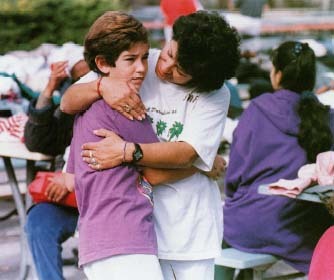 Some people develop post-traumatic stress disorder after living through terrifying events. Here, a mother comforts her son at a Red Cross shelter after the Northridge, California, earthquake of January 21, 1994.Corbis/Reuters.
 - Exaggerated displays of fear. People often overreact to ordinary situations. For example, people who were mugged might jump when someone taps them on the shoulder, while hurricane survivors might get scared during an ordinary thunderstorm.
People with post-traumatic stress disorder also may have difficulty sleeping, because they are trying to avoid nightmares. They may be too protective of themselves and loved ones and avoid situations where most people would say there is no danger. They may become easy to anger, or they may experience chest pains, rapid breathing, or dizziness for no apparent reason.
How Is Post-Traumatic Stress Disorder Diagnosed and Treated?
Many people might think about past events, especially ones that caused pain. This does not mean that they have post-traumatic stress disorder. For the disorder to be diagnosed, the symptoms must last for at least a month and lead to difficulties at school, work, home, or other social situations.
Help for Post-Traumatic Stress Disorder
Counselors and techniques for treating post-traumatic stress disorder include:
- crisis counselor: a professional who provides emotional support, practical help, and information to individuals or groups who recently have survived large-scale violence or disasters.
- clinical psychologist: a mental health professional who has earned a non-medical doctoral degree. Clinical psychologists can do psychological testing and provide mental health counseling.
- group therapy: mental health counseling that involves the person, a therapist, and other people with similar problems. The group talks about each other's problems.
- psychiatrist: a medical doctor who has completed specialized training in the diagnosis and treatment of mental illness. Psychiatrists can prescribe medications, diagnose mental ill-nesses, and provide mental health counseling.
- relaxation techniques: exercises such as meditation that help people reduce the physical symptoms of stress.
- victim's advocate: a professional who provides emotional support, practical help, and information to victims of a crime such as sexual assault.
Symptoms of post-traumatic stress disorder sometimes are hidden. Often people do not want to talk about past trauma. In some cases, they may feel guilty that they survived when others died, such as in a large natural disaster. In other cases, they may blame themselves for what happened, because they think that they should have been able to fight off or escape from their attacker.
Diagnosis of post-traumatic stress disorder involves finding out what happened to the person and how it is affecting them now. Usually, this means working with a mental health specialist, such as a psychiatrist or clinical psychologist.
Counseling helps people learn how to cope with the feelings they have. The results typically are best when these discussions occur shortly after the trauma. This is one reason why specialists are brought to schools soon after a violent incident or to towns soon after a disaster. A crisis counselor is a specialist who provides short-term help to individuals or groups who recently have been through large-scale violence or disasters. Similarly, a victim's advocate is a specialist who helps crime victims find professional help.
It often is harder to treat people who show symptoms of post-traumatic stress disorder years after the traumatic event. Mental health specialists often use relaxation techniques and group therapy with others who have had similar experiences. Mental health specialists also might expose patients gradually and carefully to situations that remind them of their trauma. A car crash survivor, for example, might not want to drive again, so the person might first sit in a parked car, then drive in a deserted parking lot to overcome the fear. Prescription drugs also may be used to help a person sleep or to ease depression.
The best hope for people who experience a traumatic event is getting professional help quickly. Mental health specialists do not advise trying to hide the experience or just hoping that the feelings will go away on their own with time.
School Violence
If violence occurs in a school, psychologists and social workers provide counseling for students who see or experience it. Such students are at risk for post-traumatic stress disorder. Common symptoms in children include:
- Flashbacks and disturbing memories
- Recurring nightmares and dreams of death
- Belief in omens and predictions of future disasters
- Expectation of an early death
- Avoiding any reminders of traumatic experiences
- Fear of re-experiencing trauma
- Repetitive play re-enacting trauma
- Emotional numbness or anger
- Lack of interest in activities
- Frequent stomachaches or headaches
- Frequent feelings of nervousness.
Resources
Book
Porterfield, Kay Marie. Straight Talk about Post-Traumatic Stress Disorder: Coping with the Aftermath of Trauma. New York: Facts on File, 1996. An informative book for young people about post-traumatic stress disorder.
Organizations
U.S. National Institute of Mental Health, 6001 Executive Boulevard, Room
8184, MSC 9663, Bethesda, MD 20892-9663. A government institute that
provides information about post-traumatic stress disorder as well as
other anxiety disorders.
Telephone 888-8-ANXIETY
http://www.nimh.nih.gov/publicat/reliving.cfm
American Psychiatric Association, 1400 K Street N.W, Washington, DC
20005. An organization of physicians that provides information about
post-traumatic stress disorder and other anxiety disorders on its
website.
http://www.psych.org
Center for Mental Health Services, P.O. Box 42490, Washington, DC 20015.
A U.S. government agency. Its Emergency Services and Disaster Relief
Branch offers information about mental health services after a disaster
on its website, the Knowledge Exchange Network.
Telephone 800-789-CMHS
http://www.mentalhealth.org
National Center for Post-Traumatic Stress Disorder, Veterans Affairs
Medical Center 116D, 215 North Main Street, White River Junction, VT
05009. A program of the U.S. Department of Veterans Affairs. Its website
offers a wealth of information about how the disorder affects all kinds
of people, not just veterans.
http://www.dartmouth.edu/dms/ptsd
National Center for Victims of Crime, 2111 Wilson Boulevard, Suite 300,
Arlington, VA 22201. A national resource center for victims of crime.
Its website provides information about post-traumatic stress disorder in
crime victims.
http://www.ncvc.org
See also
Anxiety Disorders
Phobias
Sleep Disorders
Trauma
Comment about this article, ask questions, or add new information about this topic: