Psoriasis
Psoriasis (so-RY-a-sis) is a long-lasting skin disease that causes patches of skin to become red, thickened, and covered with silvery-looking flakes.
KEYWORD
for searching the Internet and other reference sources
Skin disorders
What Is Psoriasis?
When the American writer John Updike wrote a book about his own life, titled Self-Consciousness, he spent a whole chapter describing his personal battle with a long-lasting skin disease known as psoriasis. Updike called the chapter, "At War with My Skin." The word "psoriasis" comes from the Greek word for "to itch." The disease causes patches of skin to become red, thickened, itchy, and covered with silvery flakes.
What Causes Psoriasis?
Two out of every 100 people in the United States have psoriasis. In some cases, the disease is too mild to notice. In other cases, it is severe enough to cover much of the body. The cause of psoriasis is still unknown. Scientists do know that the disease cannot be passed from one person to another. In other words, it is not possible to catch psoriasis from someone else who has it.
Recent research suggests that psoriasis may be due to a problem with the immune system * . The immune system includes a type of white blood cell called a T cell. Researchers now think that people with psoriasis may have a problem with the immune system that causes it to make too many T cells in the skin.
People with psoriasis often notice that there are times when their skin gets worse, then gets better. The bad times, known as flare-ups, may be triggered by such things as climate changes, infections, stress, dry skin, and certain medicines. Flare-ups may also occur after the skin has been cut, scratched, rubbed, or sunburned. People whose relatives have psoriasis are more likely to also have it. Scientists are now studying families with psoriasis to try to find genes linked to the disease.
What Does Psoriasis Look Like?
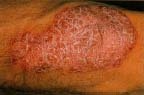
Psoriasis causes patches of red, thickened skin with silvery flakes, most often on the scalp, elbows, knees, lower back, face, inside of the hands, and bottom of the feet. These patches are sometimes known as plaques (PLAKS). They may itch or burn, and the skin may crack. The disease also can affect the fingernails, toenails, and soft areas inside the mouth and genitals. About one out of 10 people with psoriasis gets psoriatic arthritis (so-ree-AT-ik ar-THRY-tis), a condition that causes pain, swelling, and stiffness of the joints (the places where bones meet).
* immune system fights germs and other foreign substances that enter the body.
How Is Psoriasis Treated?
A doctor usually identifies psoriasis by looking carefully at the skin, scalp, and nails. If the problem is psoriasis, the doctor can try various treatments that may clear up the skin for a time. The choice of treatment depends on a person's age, health, and lifestyle and the severity of the psoriasis. No one treatment works for everyone, but most people can be helped by something. These are some of the treatment choices:
- Medicines put on the skin. Some creams, lotions, soaps, shampoos, and bath products created to treat psoriasis may be helpful. Some bath products and lotions may help loosen flakes and control itching, but they are usually not strong enough to clear up the skin.
- Treatments with light. Many people with psoriasis improve if they get sunlight every day in small amounts. To better control the light that reaches the skin, doctors sometimes use special lamps that give off ultraviolet (ul-tra-VY-o-let) rays, which are a part of sunlight. In some cases, the person also takes a medicine that makes the skin more sensitive to the ultraviolet light.
- Medicines taken by mouth. Some people with more severe psoriasis take medicines by mouth or in a shot.
Living with Psoriasis
Many people with psoriasis find that it helps to keep the skin moist. Lotions, oils, and petroleum jelly (Vaseline) are often useful for this purpose. During the winter months, heaters can make the air inside a house quite dry, so it may help to run a humidifier (hu-MID-i-fy-er), a machine that puts moisture back into the air. It is also a good idea for people with psoriasis to avoid getting harsh soaps and chemicals on their skin. In addition, they should protect their skin from injury by taking such steps as not wearing overly tight clothes or shaving with a dull razor.
Resources
Pamphlets
American Academy of Dermatology. "Psoriasis." To order,
contact the American Academy of Dermatology, P.O. Box 681069,
Schaumburg, IL 60168-1069, (888) 462-DERM.
http://www.aad.org
National Institute of Arthritis and Musculoskeletal and Skin Diseases.
"Questions and Answers About Psoriasis." To order, contact
the NIAMS Information Clearinghouse, 1 AMS Circle, Bethesda, MD
20892-3675, (301) 495-4484.
http://www.nih.gov/niams
Organization
National Psoriasis Foundation, 6600 S.W 92nd Avenue, Suite 300,
Portland, OR 97223-7195, (503) 244-7404. A national group for people
with psoriasis. The website includes a special section for children and
teenagers.
http://www.psoriasis.org
See also
Arthritis
Skin Disorders
Comment about this article, ask questions, or add new information about this topic: