Gum Disease
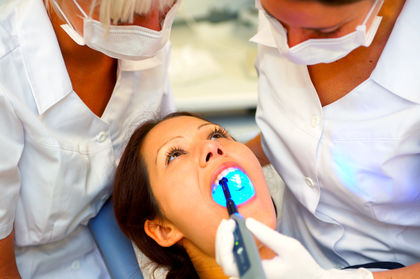
Gum disease is an infection caused by bacteria that affect the tissues surrounding and supporting the teeth.
KEYWORDS
for searching the Internet and other reference sources
Dentistry
Gingivitis
Periodontal disease
Periodontitis
What Is Gum Disease?
Like getting gray hair and wrinkles, losing teeth once seemed to be an inevitable part of growing old. The number one cause of tooth loss in adults is still gum disease, also known as periodontal (per-ee-o-DON-tel) disease. This is an infection caused by bacteria that affect the tissues surrounding and supporting the teeth. About three out of four adults over age 35 have some type of gum disease. However, tooth loss does not occur until the disease is advanced. It often can be prevented by taking good care of the teeth and gums and seeing a dentist regularly.
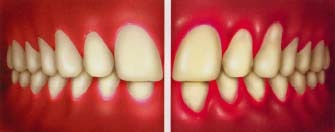
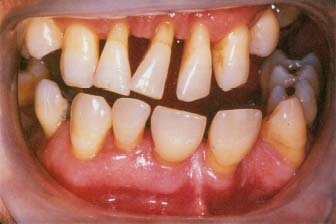
The mildest form of gum disease is known as gingivitis (gin-gi-VY-tus). It causes the gums to become red and swollen and bleed easily. At this stage, gum disease is still easily treatable. If gingivitis is left untreated, though, it can turn into periodontitis (per-ee-o-don-TY-tis), a more serious gum disease. In advanced periodontitis, the gums and the
What Causes Gum Disease?
Gum disease is caused by plaque, a sticky film on the teeth made by bacteria that live in the mouth. If plaque is not removed each day by brushing and flossing, it hardens into a rough substance called calculus, also known as tartar. The bacteria in plaque produce chemicals that irritate the gums and cause infection. If left in place, these chemicals cause the gums to pull away from the teeth and create little pockets of space between the teeth and the gums. As the infection gets worse, the pockets get deeper. The result may be the destruction of the bones in the jaw that hold the teeth in place.
Most adults over age 35 have some degree of gum disease. People who smoke or use chewing tobacco, have uncontrolled diabetes, eat poorly, or have too much stress are all at greater risk for developing gum disease. Female hormones can play a part as well; girls who are going through puberty and pregnant women also are at risk.
What Happens When People Have Gum Disease?
Symptoms
Gum disease is usually painless in the early stage. A person might not feel it until it has reached an advanced stage. However, these are some signs that a person may have gum disease:
- gums that bleed easily during tooth brushing or flossing
- red, swollen, or tender gums
- gums that have pulled away from the teeth
- bad breath that does not go away
- pus between the teeth and gums
- loose teeth
- a change in the way the teeth fit together when the person bites
- a change in the fit of a partial set of false teeth
Diagnosis
A dentist can check the gums for signs of disease. In addition to looking at them, the dentist can use a probe with a special rounded tip. This probe is moved gently around the gum line to search for pockets in the gums.
Treatment
Treatment depends on the type of gum disease and how far along it is. Cleaning the tooth surface and the root below the gum line helps the gum tissue heal and reattach to the tooth surfaces. Antibiotics can help control the growth of bacteria.
If the pockets are too deep to clean inside, the dentist may need to perform surgery to shrink the pockets. If part of the bone supporting the teeth has been destroyed, further surgery may be needed. Such surgery can reshape or rebuild the bone that has been lost.
How Can Gum Disease Be Prevented?
Brushing and flossing the teeth helps remove plaque. In the early stage of gum disease, brushing twice a day and flossing every day usually will cure the problem. Guidelines include:
- Using a soft-bristled toothbrush.
- Picking a brush that feels comfortable and will reach all the teeth, even those in back.
- Replacing the brush when the bristles show signs of wear.
- Brushing with a short, gentle, back-and-forth motion.
- Remembering to brush the inside surfaces, the back teeth, and the tongue.
- Flossing to reach plaque between the teeth and under the gum line, where a brush cannot go.
It also is important to see a dentist regularly for checkups and professional cleanings.
Resources
American Dental Association, 211 East Chicago Avenue, Chicago, IL 60611.
The leading national organization for dentists has information about gum
disease and dental care on its website.
Telephone 312-440-2500
http://www.ada.org
U.S. National Institute of Dental and Craniofacial Research, 31 Center
Drive, MSC 2290, Bethesda, MD 20892-2290. Part of the U.S. National
Institutes of Health (NIH), this agency publishes brochures and posts
fact sheets at its website about gum disease and mouth care.
Telephone 301-496-4261
http://www.nidcr.nih.gov